SW618 Mental Health Assignment Brief | Maynooth University
| University | Maynooth University (MU) |
| Subject | SW618 Mental Health |
MSocSc Social Work Module SW618
Lecturer: Dr Daniel McFadden
Case Study a Scenario Details
Context: Team Meeting, Mountainview Day Centre You are the social worker attached to the mental health multidisciplinary team (MDT) which runs the Mountainview Mental Health Services Day Centre. All people who attend the centre are being treated by the Community Mental Health Team, which includes one Consultant Psychiatrist, one Medical Registrar, four Community Mental Health Nurses, one part-time Psychologist, one Occupational Therapist, one Family Peer Support Worker, one Peer Support worker, and you, the full-time Social Worker. You have been working on the team for two years. Recently, you attended a social work CPD event where you updated your knowledge on trauma informed care and the co- occurrence of substance use and mental health issues.
At today’s MDT meeting and review, there is one new referral from in-patient service.
Anne was referred to your team, the Community Adult Mental Health Team (CAMHT). Anne (28 y/o) recently was admitted to a psychiatric unit following several months struggling with her mental health. Prior to admission, Anne spent over 16 hours in A&E in the local general hospital, having feelings of low mood and suicidal ideation. Following review by psychiatry, and during her initial few days as an inpatient, the psychiatry team came to the conclusion that Anne was presenting with symptoms which are associated with the diagnosis known as ‘persistent depressive disorder’ or ‘dysthymia’. From a psychiatrist’s perspective during their initial assessment process, Anne spoke about her experiences of long-periods of low mood in recent months, even years. She spoke about feeling empty, sad, and losing interest in everyday life and social activities. Often, Anne spoke about feeling like a failure and also experiencing times of hopelessness – leading to suicidal ideation prior to admission. During Anne’s stay, there was a high level of turnover in terms of staffing beyond the medical and nursing team – with no Social Work or OT present during her 4 week stay. Receiving a diagnosis was an initial sense of relief for Anne, but there was confusion about how to move forward. Medication was prescribed and this did seem to have a positive impact in the first two weeks of her time in hospital. However, when discharged home after 4 weeks in hospital, a referral was sent to the Community Adult Mental Health Team (CAMHT) for Full MDT Input. During MDT discussions and based on the referral, which included that Anne had been diagnosed with Dysthymia (persistent depressive disorder) it was agreed that social work input would be significant due to the impact of this type of mental illness and diagnosis, which often can impact on relationships, school, work and daily activities. The referral from the acute setting provided a more detailed understanding of Anne’s life course up until her admission just over a month ago, which provided the following information:
Anne spoke with the nursing team during her time about her past experiences, and the challenges she has faced and sought to overcome in life. She had grown up in a house where both her parents struggled with addiction, leading to her entering the care system at 9 years old. Prior to coming into care Anne, was periodically sexually assaulted by a family friend from the age of 6 to 9. Anne disclosed this after entering care and was referred to services at this time.
She had 3 siblings all of which were younger than her, with each of them being separated from each other when entering care – this was due to the shortage of placements where the 4 children could have stayed together.
They had access visits, but it was a significant struggle for Anne as the eldest not being there for her younger siblings at the time. During the latter years of her time in care, Anne built trust with her Children in Care (CIC) Social Worker, who remained the same CIC Social Worker until she left care at 18.
Entering society as an 18-year-old with little support from state services was a challenging period for Anne. While in care, preparation was made alongside her to try and prepare her for adulthood and independent living. However, she believed the state and society had failed her in many ways. In her latter adolescent years, she felt feelings of hopelessness, a failure as the eldest sister, not a good enough daughter. She also believed that her parents’ addiction and inability to care for her was her fault. Anne advised that she felt empty when trying to adjust to independent living.
She had reached out to both of her parents, but they remained in a cycle of addiction, further blaming herself for not being able to help them – leading to further experiences of failure. Anne advised that she had begun working in the local pharmacy soon after turning 18, and remained in that role until she was 24, where she had an employer who really supported her to in studying and becoming a pharmacist technician. Also, she had maintained contact with her three siblings, which she really valued and helped her to challenge her thinking regarding feeling empty and feeling hopeless. She had also met someone when she was 25, another girl who she had fallen in love with and were together for over 2 years. Her name was Sally. However, at the turn of her 28th Birthday, earlier this year, Sally ended the relationship with Anne, this was extremely difficult for her to process, she was her rock, the one she trusted and wanted to spend the rest of her life together. Anne had struggled to build a trusting sexual and romantic relationship with Sally initially, doe to her past experiences as a child and thought it impossible to do so again with someone else.
Second, her youngest sibling, Jamie (23 years old) had struggled with his mental health and had attempted to take his own life two months ago. Fortunately, he survived, but Anne has blamed herself for this event also. Anne reports that she has increasingly began to rely on alcohol to relax in the evenings. She has always drank ‘socially’ but lately she has been drinking close to a bottle of wine per day, with this increasing to two bottles at the weekend.
She recognises that this isn’t healthy and would like to change.
In the days up to being admitted to hospital, she felt that maybe she would be better off not being alive anymore, that the world would be better without her. She felt very empty and did not want to continue in life. These feelings became a lot more prevalent, and she had begun to make plans. However, her friend John called the day of her admission, and she could not hold things together, and disclosed how she was feeling to him. He brought her to hospital, and she was admitted following a long wait in A&E.
SW618 Assignment Brief
Based on the above case scenario, please answer the following questions under the following headings:
i) Explain why you think Anne’s case is a relevant referral to you as the mental health social worker (250 words)
ii) Based on your understanding of social work knowledge and theory, provide an outline of how you would approach Anne’s case in relation to his recovery journey. (750 words)
Focusing more broadly beyond the case scenario, please answer the following question:
iii) How would you provide Trauma Informed Care to Anne? Please outline with reference to the relevant TIC literature. (350 words)
(iv) Considering the four quadrant model of dual diagnosis (see Figure 1, below), within which quadrant would you assess Anne as being? Give detailed reasoning for your answer. (350 words)
The assignment should have an introduction (150 words) and a conclusion (150 words).
*****NB – it is important that for all 4 questions, references are used to support the statements and claims made in your answers. Word count: 2,000 words (not to exceed 10% of word count)
Submission Date: 6 January 2026. Submit through Moodle portal in Module
SW618
Figure 1: Four Quadrant Model of Dual Diagnosis
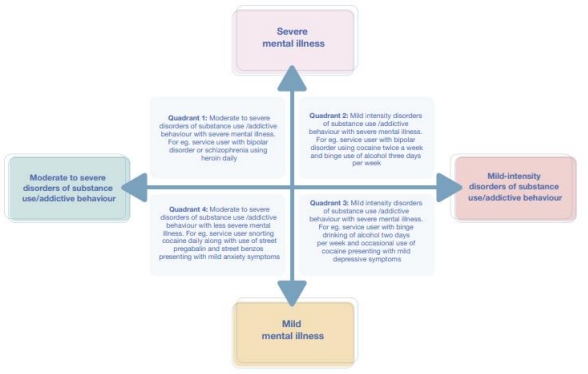
Please note: In quadrant three above, it should read /Mild intensity disorders of substance use/ addictive behaviour with LESS severe mental illness.
💡 Struggling with SW618 Mental Health case analysis and theory application?
The SW618 Mental Health assignment (Maynooth University) requires strong application of social work theory, trauma-informed care, and dual diagnosis frameworks to a complex case scenario. Many students struggle to integrate TIC literature, recovery-oriented practice, and the Four Quadrant Model while meeting strict academic and referencing standards. At Ireland Assignments, we provide human-written, ethically grounded social work assignments aligned with university expectations. Get expert guidance from maynooth Assignment Help professionals and submit confidently with Assignment Helper.