SSJ30070 Gender, War and Violence Assessment | University College Dublin (UCD)
| University | University College Dublin (UCD) |
| Subject | SSJ30070 Gender War and Violence |
SECTION 1: MODULE OUTLINE
Module Code SSJ30070
Module Coordinators Dr Mary McAuliffe
Credits 5 credits
Level 3
Semester 1
💡 Struggling with your SSJ30070 Gender, War and Violence journal entry at UCD?
Description
This module examines the gendered dimensions of war and violence. War and Violence trauma experienced by women and marginalised communities such as LGBT+, asylum seeker and migrant, is often made invisible in national, historic and post conflict narratives. We will explore and critique some basic gendered assumptions of war and violence. We will look at how wars, genocides and other forms of political/gendered violence have been narrated and represented? We will also consider different categorisations of gendered experience (home front/battle front, male/female, soldier/civilian); we will look at case studies from such diverse sites of war/violence as the Irish revolutionary struggle 1910-1922, rape as a weapon of war, the 1990’s Balkans wars, the post 9/11 War on Terror, post-troubles Northern Ireland and the Peace Process, the current wars/violence in areas like Gaza, Sudan, Congo etc and the gendered nature of war and violence, especially sexual violence, in sites of on-going conflicts around the world.
Trigger warning; This module will deal with themes of violence, in particular gendered and sexual violence against women and minority communities.
Learning Outcomes:
On completion of the module, students should be able to
On successful completion of the module students should be able to:
Understand the ongoing debates concerning gender, femininity and masculinity in relation to war and violence and be able engage in discussion of these
Demonstrate the ability to critically engage with key concepts in the study of war and political violence as a gendered process
Present scholarly ideas and engage in discussion.
Write a scholarly essay to a standard appropriate to level 3/4 students.
Competencies:
1) Written and Oral Communication
a. Students will engage in lectures and tutorial discussions, demonstrating an ability to engage in effective oral communication.
b. Students will present a mid-term assignment and will develop, research and write an effective, informed and well-argued end-of-term paper.
2) Critical Thinking
Through the end-of-term paper and other module activities, students will demonstrate an ability to critically engage with a variety of information sources and apply theoretical and interdisciplinary approaches to the major issues under discussion.
3) Information Literacy
In researching and preparing for the end-of-term term paper, as well as other class activities, students will demonstrate, without plagiarism, an ability to access and source relevant information; manage and integrate different sources; evaluate the quality and content of different sources; apply information purposefully; and communicate the information effectively.
Student Workload
| Workload: | Approximate Hours: 120 | |
| Class Contact: Lectures
Autonomous Student Learning |
24 | |
| Weekly Reading Assignments | 48 | |
| Preparation and Writing Essay
Required |
48 | |
| Attendance: Active Participation in lectures | Throughout the Semester |
Journal entry-Week 6
(800 words) 20% Midterm assignment – week 9 (800 words) 20% Essay: end of semester – week 15 (2,000 words) 60%
Assessment Details Journal entry-Week 6 (800 words) 20%
A short journal reflection (c. 800 words) that will reflect on a chosen theme (s) or issues discussed in class, referencing relevant readings up to week 6
Midterm assignment – week 9
(800 words) 20%
Mid-term assignment – 800 words, write a critical, gendered reflection/reading on a current site of conflict, using 2 to 3 readings/critical sources.
Essay: end of semester – week 15
(2,000 words) 60%
End of semester essay – 2,000 words. A list of titles (with associated readings) from which to choose one essay title will be provided.
Assignments: SSJ 30070; Gender, War and Violence
| First assignment – journal entry | 800 words
Friday 17th October 2025, submit via Brightspace |
| Mid term (Critical Reflection) – | 800 words |
| Due Date – | Monday, 7th November 2025, submit via Brightspace |
| End of term Essay – | 2,000 words |
| Due Date | Monday, 15th December 2025 submit via Brightspace |
Important Note; Students are expected to carry out analysis, produce arguments and write-up assignments without the use of generative artificial intelligence (AI) programmes. The use of AI to produce content for assignments or to complete quizzes or other assessment activities is not permitted in this module and will be regarded as a breach of academic integrity
Module Texts
This section lists the Reading(s) for each session, along with a set of Supplementary Readings. Supplementary Readings are not compulsory but inform much of the content of lecture. They will provide you with a more in-depth and detailed analysis of the issue being discussed each week and you may also find them useful for your essays or further research.
Brightspace
Most of the Readings are available in the Course Documents: Readings & Overheads section of Brightspace. Other books and book chapters not on Brightspace are available from the UCD Library, and journal articles that are not on Brightspace will be accessible through the UCD online library’s electronic journal access system. There are also many websites that you can consult for further information on the topics covered here. Please go to the External Links folder on Brightspace where they have been listed for your attention
Module Details
Module Co-ordinator:
Dr Mary McAuliffe, UCD Gender Studies
Office Hours: office hour is from 11-12am each Tuesday during term – this can be organised online or in person. Should you wish to meet please feel free to email to arrange an appointment.
Co-ordinator Contact Details:
Dr Mary McAuliffe
Office: A004, Hanna Sheehy Skeffington Building
Email: mary.mcaulif@ucd.ie Tel: 01-7168338
School of Social Justice Contact Details:
Contact: Owen Kinsella (Administrator)
Office: A001, Hanna Sheehy Skeffington Bld..
Tel: 01-7168198
Email: sp-sw-sj@ucd.ie
(SSJ 30070) – Gender, War and Violence Dr Mary McAuliffe
Course Outline and weekly readings – all required readings will be on blackboard.
This module examines the gendered dimensions of war and violence. War and Violence trauma experienced by women and marginalised communities such as LGBT+ is often made invisible in national, historic and post conflict narratives. We will explore and critique some basic gendered assumptions of war and violence. We will look at how wars, genocides and other forms of political/gendered violence have been narrated and represented? We will also consider different categorisations of gendered experience (home front/battle front, male/female, soldier/civilian); we will look at case studies from such diverse sites of war/violence as the Irish revolutionary struggle 1910-1922, rape as a weapon of war, the 1990’s Balkans wars, the post 9/11 War on Terror, posttroubles Northern Ireland and the Peace Process, and the gendered nature of war and violence, especially sexual violence, in sites of on-going conflicts around the world.
Module Outline
Week 1. Introduction – Gender, War and Violence – the origins of sexual violence in war Required Reading.
Brownmiller, Susan. 1975. ‘Chapter 1, In the beginning was the law’ from Against Our Will: Men, Women and Rape. Harmondsworth: Penguin
Kerry F. Crawford (2013) From spoils to weapons: framing wartime sexual violence, Gender & Development, 21:3
Nancy Farwell ‘War Rape: New Conceptualizations and Responses’ AFFILIA, Vol. 19 No.
4, Winter 2004 389-403
Further Readings
Maja Korac ‘Feminists against Sexual Violence in War: The Question of Perpetrators and
Victims Revisited’, Soc. Sci. 2018, 7, 182
Linda Grant DePauw ‘Introduction; Definitions and Presuppositions’ in Battle Cries and
Lullabies; Women in War from prehistory to the present. (Oklahoma, 1998)
Cynthia Enloe ‘How does National Security become Militarised’ in Globalisation and
Militarism (New York, 2007)
Joan Wallach Scott, “Gender: A Useful Category of Historical Analysis,” in Joan Wallach Scott, Gender and the Politics of History (New York, 1988)
Week 2. The Irish revolutionary struggle 1910-1922 Required Reading.
Louise Ryan ‘Drunken Tans’: Representations of Sex and Violence in the Anglo-Irish War
(1919-21) Feminist Review, No. 66, Political Currents (Autumn, 2000), pp. 73-94
Lindsay Earner-Byrne The Rape of Mary M.: A Microhistory of Sexual Violence and Moral
Redemption in 1920s Ireland Journal of the History of Sexuality, Vol. 24, No. 1, January
2015
Mary McAuliffe ‘The Treatment of Militant Anti-Treaty Women in Kerry by the National
Army during the Irish Civil War’, Éire/Ireland, 59 (3 & 4),
2023 https://muse.jhu.edu/article/910480
Further Readings
Justin Dolan Stover Families, Vulnerability and Sexual Violence During the Irish
Revolution in J. Evans, C. Meehan (eds.), Perceptions of Pregnancy from the
Seventeenth to the Twentieth Century, Genders and Sexualities in History,
DOI 10.1007/978-3-319-44168-9_4
Laura McAtackney Gender, Incarceration Power Relations, during the Irish Civil War in
Victoria Sanford et al (eds) Gender and Violence in Peace and War; States of Complicity
Susan Byrne (2020): ‘Keeping company with the enemy’: gender and sexual violence against women during the Irish War of Independence and Civil War, 1919–1923, Women’s History Review
Week 3. The Troubles In Northern Ireland – gender and sexual violence Required Reading.
Theresa O’Keefe ‘Strip searches, sexual violence and feminism during the war in Northern / Ireland’ in Jennifer Redmond and Mary McAuliffe (eds) The Politics of Gender and Sexuality in Modern Ireland ;A Reader (Four Courts, 2024)
Aisling Swaine ‘Resurfacing Gender: A Typology of Conflict-Related Violence Against
Women for the Northern Ireland Troubles’, Violence Against Women, 2023, Vol. 29(6-7) 1
Nell McCafferty, Armagh is a Feminist Issue in Nell; The McCafferty Reader (lilliput Press, 2005)
Further Readings
Theresa O’Keefe ‘Policing unruly women: The state and sexual violence during the
Northern Irish Troubles’, Women’s Studies International Forum, Volume 62,, May–June
2017
Begona Aretxaga ( 2001). ‘The sexual games of the body politic: Fantasy and state violence in Northern Ireland’. Culture, Medicine and Psychiatry , 25, 1-27.
Monica McWilllams, ‘Violence Against Women and Political Conflict: The Northern Ireland
Mary McAuliffe and Laura Hale ‘Blood on the Walls’; Gender, History and Writing the Armagh Women in Gillian McIntosh and Diane Urquhart Irish Women at war; the 20th century (Dublin, 2010)
week 4. Colonization, gender and sexual violence Required Reading.
Lugones, Maria. 2008. ‘The Coloniality of Gender’, in Worlds & Knowledges Otherwise (Spring): 1-17
Jemma Tosh Rape me, I’m Irish”: An analysis of the intersecting discourses of anti-Irish racism and sexual violence. intersectionalities: A Global Journal of 2015Social Work Analysis, Research, Polity, and Practice, 2015
UNITED NATIONS INDEPENDENT EXPERT ON PROTECTION AGAINST VIOLENCE
AND DISCRIMINATION BASED ON SEXUAL ORIENTATION AND GENDER IDENTITY –
IESOGI ‘The impact of colonialism in violence and discrimination based on SOGI (sexual orientation and gender identity)’
Further Readings
Sandrina de Finney ‘Indigenous girls’ resilience in settler states: Honouring body and land sovereignty Empowering women for gender equity’ Volume 31, 2017 – Issue 2: Moving the Social Ecology to the Centre: Resilience in the Context of Gender Violence
W Kubik, C Bourassa, M Hampton ‘Stolen sisters, second class citizens, poor health: The legacy of colonization in Canada’ Humanity & Society, 2009
Allison McKibban ‘Speaking Out’ against Colonialism and Sexual Violence
https://shame.bbk.ac.uk/blog/speaking-out-against-colonialism-sexual-violence-by-allisonmckibban-unsilenced-institutional-sexual-violence/
Week 5 Gender, War, Violence – Victims, protagonists, propaganda – 1960s-2000
Required Readings
Gaby Zipfel ‘“Let Us Have a Little Fun”: The Relationship between Gender, Violence and
Sexuality in Armed Conflict Situations’ RCCS Annual Review A selection from the
Portuguese journal Revista Crítica de Ciências Sociais 5 | 2013 Issue no. 5
Valerie Wieskamp “Sexual Assault and the My Lai Massacre: The Erasure of Sexual
Violence from Public Memory of the Vietnam War,” in Mythologizing the Vietnam War:
Visual Culture and Mediated Memory, eds, Jennifer Good, Val Williams, Paul Lowe and Brigitte Lardinois (Newcastle upon Tyne, UK: Cambridge Scholars Publishing, Forthcoming December 2013).
Further readings
BRIGITTE L. NACOS ‘The Portrayal of Female Terrorists in the Media: Similar Framing
Patterns in the News Coverage of Women in Politics and in Terrorism’ Studies in Conflict &
Terrorism, 28:435–451, 2005
Rhonda Copelon, “Gender Crimes as War Crimes: Integrating Crimes against Women into International Criminal Law” (2000) 46:1 McGill LJ 217.
Mariana Miggiolaro Chaguri and Flávia X. M. Paniz WOMEN’S WAR: GENDER
ACTIVISM IN THE VIETNAM WAR AND IN THE WARS FOR KURDISH AUTONOMY,
Sociol. Antropol. vol.9 no.3 Rio de Janeiro Sept./Dec. 2019
Helle Rydstrøm Gendered Corporeality and Bare Lives: Local Sacrifices and Sufferings during the Vietnam War Signs Vol. 37, No. 2, Unfinished Revolutions A special issue edited by Phillip Rothwell (January 2012)
Film:
Intended consequences (2008) Dir. Torgovnik http://www.youtube.com/watch?v=NqaOYV3ykPQ
If you can source this film – worth a view
The Whistleblower (2010) Dir. Larysa Kondracki
Week 6. Masculinities/femininities – the gendering of war/violence
Required Reading.
Susan Faludi ‘Perfect Virgins of Grief’ in The Terror Dream (New York, 2012)
Susan Faludi ‘The Return of Superman’ in The Terror Dream (New York, 2012)
Bonnie Mann. `How America Justifies Its War: A Modern/Postmodern Aesthetics of Masculinity and Sovereignty’, Hypatia 21(4), 2006
Further Readings
Laura Sjoberg and Caron E Gentry ‘Triple Transgressions at Abu Ghraib’ in Mothers,
Monsters, Whores; Women’s Violence in Global Politics (London 2007)
Zillah Eisenstein. “Resexing the Wars of/on Terror.” Sexual Decoys: Gender, Race and
War in Imperial Democracy. London and New York: Zed Books, 2007
Trigger Warning – the below are difficult readings dealing with a difficult but important issue – please be aware of this, if you are not comfortable reading these or watching the videos, then you can of course choose not to
Week 7. Rape as a weapon of war
Required Reading.
Brownmiller, Susan (1994) ‘Making Female Bodies the Battlefield’, in A. Stiglmayer (ed.) Mass Rape: The War against Women in Bosnia-Herzegovina,
Paul Kirby ‘How Is Rape A Weapon Of War?: Feminist International Relations, Modes of
Critical Explanation and the Study of Wartime Sexual Violence’ European Journal of International Relations
Further Readings
Milillo, D., 2006. Rape as a tactic of war. Affilia: Journal of Women and Social Work, 21, 196 Á 205.
Meredeth Turshen ‘The Political Economy of Rape; An analyses of systematic rape and sexual abuse of women during the armed conflict in Africa’ in Caroline Moser, Fiona Clark (eds) Victims, perpetrators or actors?: Gender, armed conflict and political violence (London, 2001)
Lene Hansen `Gender, Nation, Rape: Bosnia and the Construction of Security’ , International Feminist Journal of Politics 3(1) 2001
Cindy S. Snyder, Wesley J. Gabbard, J. Dean May and Nihada Zulcic ‘On the
Battleground of Women’s Bodies: Mass Rape in Bosnia-Herzegovina’. Affilia ; Journal of
Women and Social Work 2006; 21; 184
Maria Eriksson Baaz & Maria Stern (2018) Curious erasures: the sexual in wartime sexual violence, International Feminist Journal of Politics, 20:3, 295-314
Week 8 (Monday 27th October, Bank Holiday) – reading week, no in person class
Critical reading assignment due Friday 7 th November – please upload to Brightspace
Week 9. (In person classes resume, 3rd Nov )
Rape as a weapon of war Required Reading.
Claudia Card ‘Rape as a Weapon of War’ Hypatia Special Issue, Women and Violence,
Vo. 1996
Meredeth Turshen ‘The Political Economy of Rape; An analyses of systematic rape and sexual abuse of women during the armed conflict in Africa’ in Caroline Moser, Fiona Clark (eds) Victims, perpetrators or actors?: Gender, armed conflict and political violence (London, 2001)
Further Readings
Milillo, D., 2006. Rape as a tactic of war. Affilia: Journal of Women and Social Work, 21, 196 Á 205.
Guido Veronese a, Bilal Hamamra b, Fayez Mahamid c, Dana Bdier c, Federica Cavazzoni
‘Intersectional violence against women in Gaza amidst genocide’, Women’s Studies
International Forum, Volume 110, May–June 202
Anwar Mhajne, Understanding Sexual Violence Debates Since 7 October: Weaponization and Denial, Journal of Genocide Research, 2024
Cindy S. Snyder, Wesley J. Gabbard, J. Dean May and Nihada Zulcic ‘On the
Battleground of Women’s Bodies: Mass Rape in Bosnia-Herzegovina’. Affilia ; Journal of
Women and Social Work 2006; 21; 184
Liz Kelly `Wars Against Women: Sexual Violence, Sexual Politics, and the Militarised State’, in Susie Jacobs , Ruth Jacobson & Jen Marchbanck, eds, States of Conflict:
Gender, Violence, and Resistance.(New York: 2000)
‘Israel is on notice for using sexual violence against Palestinians. It’s all too common as a war tactic
https://theconversation.com/israel-is-on-notice-for-using-sexual-violence-againstpalestinians-its-all-too-common-as-a-war-tactic-262951
Week 10. War, propaganda and gender Required Reading.
Gabi Schlag and Axel Heck ‘Securitizing Images the Female Body and the war in
Afghanistan’ in the European Journal of International Relations 0 (1)2012
Jeff Walsh ‘Elite Women Warriors and Dog Soldiers: Gender Adaptations in Modern War
Film’ in Angela K Smith (ed) Gender and Warfare in the Twentieth Century; textual
Representations (Manchester, 2013)
Lene Hansen `Gender, Nation, Rape: Bosnia and the Construction of Security’ , International Feminist Journal of Politics 3(1) 2001
Further Readings
Susanne zur Nieden, “Erotic Fraternization: The Legend of German Women’s Quick Surrender,” in Home/Front: The Military, War and Gender in Twentieth-Century Germany, ed. Karen Hagemann and Stefanie Schüler-Springorum (Oxford, 2002)
Eksteins, Modris, “War, Memory, and Politics: the Fate of the Film all Quiet on the Western Front”, Central European History 13:1 (1980)
Week 11 Women and war memory; women and peace
Required Reading.
Lentin, Ronit. “Femina sacra: Gendered memory and political violence.” Women’s Studies
International Forum 29, 5, 2006: 463-473
Martin Forker ‘The Role of Motherhood Symbolization in the Conflict Imagery of Northern
Ireland’ Visual Culture & Gender, Vol. 2, 2007
Sayigh, Rosemary, “Women’s Nakba Stories: Between Being and Knowing” in Nakba: Palestine, 1948, and the Claims of Memory, eds. Ahmad H. Sa’di and Lila Abu-Lughod, New York Columbia University Press: 2007, 135-158.
Further Readings
Horowitz, Sara R.. “Gender, Genocide, and Jewish Memory.” Prooftexts 20(1/2) 2000: 158-190
Graham Dawson ‘Trauma, memory and politics; paradoxes of the Irish peace process’ in
Making Peace with the past, memory trauma and the Irish troubles (Manchester, 2007)
Sylvia Schraut & Sylvia Paletschek ‘Remembrance and gender; Making gender visible and inscribing women into memory culture’ in The gender of memory: cultures of remembrance in nineteenth- and twentieth century Europe.(Frankfurt, 2008)
Jenny Edkins Trauma and the Memory of Politics. (New York, 2003)
Sahla Aroussi, working paper (not for citation) presented to the Second Institute for African
Transitional Justice Roundtable: Gender silences in memorialisation: The case of Northern Ireland
Skjelsbaek, I,. ‘Sexual violence in times of war: a new challenge for peace operations’ Journal of International Peacekeeping , 8, 69 Á 84, 2001
Enloe, Cynthia, 1987. `Feminist Thinking About War, Militarism, and Peace’, in Beth B.
Hess & Myra M. Ferree, eds, Analyzing Gender. Newbury, CA: Sage (526-547).
Week 12 – reflection and review – (course review and end of term Assignment clinic)
Required reading
Cornelia Mosser ‘The Scandal of Women’s Emancipation. Femonationalism, Right-Wing
Sexual Politics, and Anti-Feminism’, Social Politics 2022 Volume 29 Number 4
End of Term essay due on Monday 15th December
💡 Need human-written, AI-free help for Gender, War and Violence assignments?
SECTION 2: Assessment Guidelines 2025-2026
This section outlines the assessment process, including what you can expect and what is expected of you. It offers guidelines with regard to the different components that comprise the overall assessment of the module. Please feel free to ask if you have any further questions in this regard.
| Important Documents
A number of documents are available of Brightspace to assist you in successfully completing your assessments for this module. Please refer to the ‘Assignments’ folder on Brightspace and select ‘Writing Skills’ folder stored in there. These documents cover three important areas: • Assistance in Writing Reports and Essays Includes links to websites providing tips on producing well written essays (e.g. http://www.write-an-essay.com). You can also download two chapters from Aidan Moran’s (2000) Managing Your Own Learning at University: A Practical Guide, Dublin: University College Dublin Press: o Improving Your Reading and Summarising Skills: Tackling Textbooks (Chapters 5); o Planning and Writing Essays, Papers and Research Projects (Chapter 9).
• Reference and Citation Style Guide |
||||
A Types of Assessment:
This module employs a variety of assessment procedures within a blended assessment model. This spreads exercises and activities throughout your period of study – supplements the more traditional assessments concentrated at the end of a term or academic year
This module is allocated 5 credits, which will be awarded on satisfactory completion of the module the associated assessments. The three types of activities – and their relevant weighting – on which you will be assessed for this module are listed in the table below:
| Activities | Weighting (Total: 1) |
| 1. End-of-Term Essay | 80% |
| 2. Mid term assignment | 20% |
1 Attendance & Participation
Participation in lectures is a vital aprt of this module. Lectures will offer detailed discussion on the weekly topic, building on your reading prior to the lecture.
2 Readings
The majority of Readings for this module are available for download on Brightspace, under the Course Documents segment. Other books and journal articles will be available in the library or through UCD’s online access to journals.
3 Completed End-of-Term Essay Deadline
This section details some general guidelines on essay writing, essay requirements and the main criteria that will be used in assessing your essay. It is not uncommon for final essays to differ in some way from the original essay outline and bibliography. But by completing an essay outline, you will have begun the process of thinking about, researching and writing for an essay and will have generated a blueprint that you can refer back to when completing your essay.
Essay Writing
Over time you will develop your own system for reading, taking notes and writing. However, despite differences between people’s approaches to essay writing, there a few common steps to be taken:
Establish your topic
Look for sources of information
Read your sources, take notes and record your references
Organise your ideas/update your essay outline
Write a first draft
Write a bibliography
Revise the first draft
Proof-read the final draft
If possible, have someone else proof-read your essay before submitting.
Diagram 1:
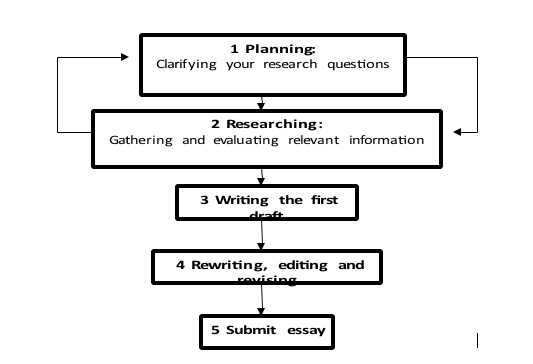
Main Stages of Essay Writing (Moran, 2000: 120)
Every good essay should follow this basic structure:
1. Introduction (Outline of the topic/overview)
-
- The opening section of your essay introduces the reader to your topic, and often begins with a general statement about the topic and ends with a more specific statement of the main idea of your essay. The purpose of the introduction is to outline what you are going to say, to let the reader know what the topic is, to engage the reader’s curiosity, to pose a question/problem which you intend to address, and highlight which aspects of the topic you will be focusing on. Ultimately, the introduction should captivate the reader’s attention and give an idea of the essay’s focus.
Tip: It is often easier to write up the final version of your introduction at the end of the essay process, when you know what shape your final draft has taken. This allows you to accurately state what you have covered in the essay.
2. Body (consisting of sub-sections)
-
- The body of your essay consists of a number of sub-sections in which you develop your ideas in detail. You may use sub-headings for this if you wish, but are not obliged to.
- The body should be structured in a way that makes your argument flow and read logically. Therefore, planning how/when you will be introducing the different points and evidence you will be including is important in producing a good essay body. Each sentence should also lead the reader into the next sentence, and every paragraph should tackle a key point or idea.
- Ensure you prove your points continually by using specific examples, quotations, reference to the source (e.g. According to Cullen (2000), …). If you are using the author’s words verbatim (4 consecutive words and more), you need to reference with quotation marks, name, date and page numbers. If you are paraphrasing an author’s ideas, you can just use their name and date of the text.
3. Conclusion
A conclusion should be included, summing up the points in the essay. The conclusion should clearly review the main points, being careful not to restate them word for word.
4. Bibliography
In your bibliography you will be expected to list the sources you have consulted and intend to use. You will be expected to demonstrate you have independently sought additional sources on your own, and so while you are welcome to use the sources listed in this module outline, you also need to seek at least one additional new source.
For your bibliography, it is important that you familiarise yourself with referencing styles, as your referencing and bibliography will be considered in assessment. There are a variety of citation styles. Here are examples of the Harvard referencing system:
Format for listing books –Name (Year) Title, Place of Publication. Publication Company:
- g. Cullen, P. (2000) Refugees and Asylum Seekers in Ireland, Cork. Cork
University Press
Format for listing articles – Name (Year) Article Title, Journal Title, Journal Volume and Number, page numbers: o e.g. Dillon, E. & D. Grießhaber (1996) Challenging the Portrayal of the
Majority World,, Anthropology Ireland, Vol.5. No. 2, pp32-42.
Format for listing websites –Author (where identified) Name of article, date retrieved from internet, Full URL
- g. Joseph, J. Harvard Referencing Retrieved: December 2006, from http://lisweb.curtin.edu.au/reference/harvard.html
Please use the above system if you are unfamiliar with referencing systems. However, the standard rule for your referencing and bibliography style should be that they are consistent and supply all relevant details of the publications. Please refer to the Citing References and Creating Bibliographies in the Course Documents > Writing Skills folder on Brightspace for more information on referencing books, journal articles, web sources etc.
Essay Requirements
Your essay should not simply present information, but should instead be a way to demonstrate your analytical skills and critical engagement with the topic. In order to write a persuasive essay, you should incorporate the implications and relevance of the topic, as well as evidence that you have tackled critically with the topic.
In your essay you are required to incorporate at least two of the major topics covered in the module, for example, migration and the labour market or feminist perspectives and poverty. This is to encourage you to make connections between the different, yet highly interrelated, topics that will be discussed throughout the module. Also, when writing your essay please ensure that it reflects the general theme of the module.
Max Length: A Level 3 essay – The length of your essays should be 2,500-3000 and should not exceed 3,000 words.
You will be expected to:
Define the major terms you employ;
Discuss different arguments of the main issue under analysis;
Clearly identify the central arguments you are presenting;
Demonstrate an awareness of possible criticisms and limitations of arguments; Appropriately reference sources of information and include a bibliography.
With regard to presentation:
Use 1 inch margins, a normal font size, and double-spacing.
Pages should be numbers.
Do not insert double-returns between paragraphs.
Please provide a title page containing:
- your student number and not your name;
- the title of your essay; o the module name; o date submitted.
You are encouraged to use double-sided printing if possible. Printers on the UCD campus have facilities for double-sided printing, so please ask IT Student Services how to go about doing that.
Main Criteria for Assessment:
When writing and revising your essay you should consider the following, as these are the main criteria on which assessment of your assignment will be based:
Relevance: Does your essay answer the question asked? Is everything in it relevant to the question?
Structure: Is your essay broken into paragraphs, well structured and controlled? Does it have a clear direction and cohesion?
Knowledge: Does your essay show accurate knowledge of and indicate that you have studied the readings covered in the module? Does your essay go beyond the readings assigned? Does it integrate module themes and maintain a global focus?
Understanding: Do you have a clear understanding of the readings and issues, and of how different authors have dealt with them? Are ideas clearly expressed? Have technical terms and concepts been fully explained?
Argument/Analysis: Has the essay analysed, as opposed to just described, the issues? Does it demonstrate an ability to argue a point of view and to assess the strengths and weaknesses of other related arguments?
Presentation: Have all presentation requirements been met? Are claims backed up by references? Is the essay appropriately referenced and does it include a bibliography?
Self-Assessing Your Essay
The table below can be used by you to rate your essay and help identify areas that you might need to give further attention to before submitting:
| Criteria | Standard (Grade) | Standard (Grade) |
| Relevance to question asked | Excellent (A/+/-)
Very Good (B/+/-) Good (C/+/-) Satisfactory (D+, D) |
Acceptable (D-)
Marginal (E) Unacceptable (F) Wholly Unacceptable (G) |
| Structure/organisation/control | Excellent (A/+/-)
Very Good (B/+/-) Good (C/+/-) Satisfactory (D+, D) |
Acceptable (D-)
Marginal (E) Unacceptable (F) Wholly Unacceptable (G) |
| Knowledge/Integration of Module Themes | Excellent (A/+/-)
Very Good (B/+/-) Good (C/+/-) Satisfactory (D+, D) |
Acceptable (D-)
Marginal (E) Unacceptable (F) Wholly Unacceptable (G) |
| Understanding of
material/Clarity of expression |
Excellent (A/+/-)
Very Good (B/+/-) Good (C/+/-) Satisfactory (D+, D) |
Acceptable (D-)
Marginal (E) Unacceptable (F) Wholly Unacceptable (G) |
| Argument/Analysis/Critical Evaluation | Excellent (A/+/-)
Very Good (B/+/-) Good (C/+/-) Satisfactory (D+, D) |
Acceptable (D-)
Marginal (E) Unacceptable (F) Wholly Unacceptable (G) |
| Presentation (length, spelling, proof-reading, referencing, bibliography) | Excellent (A/+/-)
Very Good (B/+/-) Good (C/+/-) Satisfactory (D+, D) |
Acceptable (D-)
Marginal (E) Unacceptable (F) Wholly Unacceptable (G) |
Submitting Your Essay:
Please ensure you are familiar with the policies on Academic Integrity and Late Assignments discussed below before submitting your essay.
Printed copies of essays should be submitted into the School Office
All essays must be accompanied by a signed copy of the Assignment Submission Form. This form is available on Brightspace within the Assignments folder. You must also get this stamped in the School as evidence of having submitted the essay. A stapled copy is sufficient, as bound assignments or assignments placed in plastic folders incurs an unnecessary expense for you. However, essays should be typed. Faxed or e-mailed copies of essays will not be accepted.
B General Guidelines on Submitting Material
Please keep a copy of all assignments. Assignments should not be emailed or faxed unless this has been arranged prior to the submission date. Extensions will only be granted in exceptional circumstances. Requests for extensions must be made prior to the due date and must be submitted in writing, along with all relevant documentation, e.g. doctor’s certificate. Please complete and submit the standard University pro-forma ‘Application Form for Late Submission of Assessment’ uploaded to the Assignments Folder on Brightspace.
Where module assignments are submitted late due to exceptional or extenuating circumstances, you must present an explanation to the module coordinator, using the standard University proforma. After consultation with the School, an extension may be awarded retrospectively in such cases.
Please contact me as soon as possible where such issues arise, and please be assured that it will be treated with the utmost confidentiality.
- Academic Integrity:
You are expected to be familiar with and abide by UCD policy on Academic Integrity and
Plagiarism (http://www.ucd.ie/sils/plagiarism.htm). This policy has also been uploaded on Brightspace for your attention. It is available from the Writing Skills folder in the Course Documents section on Brightspace. Please ensure that you are familiar with this policy as evidence of plagiarism and cheating incurs severe penalties.
- Late Assignments:
In the interest of fairness, assignments submitted after the deadline, unless granted an extension, will be subject to a penalty:
Essay Outline and Bibliography/End-of-Term Paper
Written work submitted any time within one week after the due date will incur a penalty of two grade points, e.g. an assignment which is awarded an A+ but is submitted within one week after the due date will be penalised by two grade points and be returned as an A-. Written work submitted after that, but within two weeks of the due date, will be deducted four grade points, e.g. A+ will be returned as a B. Assignments submitted more than two weeks late, as suggested by UCD policy, will not be graded.
💡 Can't Complete Your SSJ30070 Gender, War and Violence Assessment On Time?
The SSJ30070 Gender, War and Violence assessment demands deep critical analysis, ethical sensitivity, and strict adherence to UCD’s academic integrity rules. Many students find it challenging to engage with gendered violence theories, case studies, and scholarly readings without crossing plagiarism or AI-use boundaries. At Ireland Assignments, our subject experts provide 100% human-written, AI-free UCD assignments support aligned with international university standards. Get guided assistance from Gender Studies Assignment Help specialists for journals, critical reflections, and end-term essays. Explore trusted academic services through Ireland Assignment Helper and submit your work with confidence.