ENVI7001 Environmental Science and Industrial Hygiene Case Study 2026 | MTU
| University | Munster Technological University (MTU) |
| Subject | ENVI7001 Environmental Science and Industrial Hygiene |
ENVI7001 Environmental Science and Industrial Hygiene 2025/26 Semester 2 Laboratory Manual
Case Study Introduction
Lab 1: & Chemical Water Tests:
- Case Study Introduction: An extensive gastroenteritis outbreak due to suspected contamination of a municipal drinking water supply
- Determination of nitrate in water samples
- Determination of nitrite in water samples
- Determination of phosphate in water samples – SAMPLE DATA
Lab 2: Physical Water Tests:
- Determination of suspended solids in water samples
- Determination of turbidity of water samples
- Determination of pH of water samples
- Descriptive tests – odour
Lab 3: Biological Water Quality Tests:
- Determination of total coliform numbers using membrane filtration
- Determination of total coliform numbers using Most Probable Number (MPN) testing
Lab 4: Biological Water Quality Tests:
- Bacteriological characterisation of water samples using Gram staining
- Bacteriological characterisation of water samples using API strips
➢ Need Help With ENVI7001 Water Contamination Case Study?
All students and laboratory users are obliged to read this section
- In case of accident, notify your Supervisor/instructor/lab manager immediately. First Aid kits are available in Technicians preparatory rooms (off the laboratory) and also in the chemical store. Students should not work alone in the laboratory. All accidents resulting in injury, fire, or damage to property or equipment must be reported to the laboratory supervisor. An accident form must be completed for each accident regardless of how minor the accident is deemed to be.
- Medical assistance can be obtained by dialling ext. 6112 (Emergency Response Team) or ext. 5782 (CIT Medical Unit) from a campus phone. The medical unit is located in the student centre.
- Students must not enter the laboratory or commence practical without the permission of the practical supervisor. Students must seek permission of the supervisor before leaving during the practical session; the supervisor must be informed of the reason for leaving.
- Familiarise yourself with the location of the nearest emergency exit, the fire extinguisher (it’s by the door) and the nearest safety shower or eyewash station (at sink). Access to the emergency/safety equipment must not be impeded.
- Place only those materials needed for the day’s laboratory exercise on the bench-tops. Bags, coats, extra books, etc., should left elsewhere (either be placed on the coat rack outside the lab or in your locker). Do not place them where others might trip on them. Keep all workspaces as tidy as possible. Do not bring mobile phones into the lab as they can constitute an ignition hazard for flammable materials.
- Wear your white lab coat at all times. Failure to do so will result in you being excluded from practicals. Ensure your coat is laundered regularly. Keep coat buttoned up when working in the lab.
- It is advisable not to wear open toed shoes (sandals). In fact, even wearing running shoes with an open-weave surface is a hazard. Your feet are susceptible because you often hold bottles in front of you when you walk – if the bottle breaks, the material lands on your feet. If the liquid is corrosive or boiling hot, your feet will be burned. Platforms or shoes with elevated heels should also be avoided.
- Wear your safety goggles at all times in the laboratory. Failure to do so will result in you being excluded from practicals. Ensure you bring your goggles with you to each practical session.
- Do not eat, drink, smoke, apply makeup or chew gum, pencils, fingernails, etc. in the laboratory, nor should you “mouth pipette”. This is a standard rule in all biology/ microbiology/ molecular biology labs – particularly those in which potentially pathogenic organisms, toxic substances or radioactive compounds are used. The reason is that these behaviours can lead to your ingesting chemicals, micro-organisms, etc. Horse-play or practical joking of any kind in the lab is dangerous and is thus forbidden. Wash your hands thoroughly with soap and water at the beginning and end of each laboratory session.
- Take care when lifting large bottles or equipment. Use both hands and ensure your pathway is clear.
- Be careful when using mechanical equipment with moving parts (i.e. the belt drive on the vacuum pump can catch long hair or loose clothing). Familiarise yourself with the instructions for safe operation of the equipment before using. Instructions for safe operation are posted beside the equipment. If you are still unsure how to operate equipment, ask your instructor or a technician. Do not remove equipment from the lab without permission.
- Electrical equipment must not be handled with damp or wet hands and the work-space where it is to be used must be dry; power cables must be inspected for damage before use. Defective items must be reported to the lab supervisor, and must not be used. Students must never attempt to repair defective items of electrical equipment.
- Hotplates must be used with care and must not be allowed to overheat. Flammable liquids should not be heated on a hot plate; use a hot-water bath instead.
- Use caution around the Bunsen Burners. In a busy lab, it is easy to lean over a burner and ignite your hair or clothing. Keeping long hair tied up can reduce the risk of such an injury. Keep the Bunsen near the centre of the bench and take precautions to avoid it coming in contact with containers of alcohol or other flammable substances. If alcohol does ignite, don’t panic, keep clear and notify instructor immediately.
- Chemicals must never be tasted, and should only be smelled with extreme caution. Do not remove chemicals from the lab unless instructed by the instructor.
- Corrosive or dangerous chemicals (i.e. phenol, acids etc.) should be used with extreme caution as many of these can cause very severe burns, particularly to hands, face or eyes. Store all such chemicals in a Chemical Hood. When you are working with them, wear eye goggles and gloves. Always familiarise yourself with the individual hazards for each chemical (read the label).
- Organic liquids must as far as possible be handled with care in a fume-hood. Flasks and beakers containing such substances should be labelled and must not be left on benches outside a fumehood.
- Disposal of waste chemicals/biologicals. Every effort must be taken to minimise generation of waste material. Use the minimum amount of material necessary. These materials should be disposed of in the appropriate receptacles, not in the trash or sink. All biological material must be autoclaved before disposal. For further details on specific waste disposal, ask laboratory instructor.
- Report spillages to the lab instructor – biological spills should be properly disinfected.
- Where material is being stored/incubated for the next practical, proper labelling of all your cultures, media, solutions, tubes, etc., is essential. After classes, place your initials and a number that refers back to your Class and lab book, and an indication of the contents on all material being incubated or stored for later use.
- Broken glass and any other sharp objects should not be put in the waste bin – they might injure maintenance staff. Dispose of in the receptacle marked “Broken Glass”. Defective glassware must not be used. Notify lab supervisor about chipped or cracked items.
- Do not expose your eyes to ultraviolet light (for example, the trans-illuminator). Use goggles and the UV-opaque face shield or a Plexiglas cover.
- Do not create aerosols of microorganisms or dangerous chemicals.
- Be careful when handling microwaved or autoclaved solutions. They may be superheated and therefore can boil over and burn your hands if container is shaken.
- ***NB: Tidy up carefully and disinfect all areas where you worked before you leave the lab***
Laboratory Safety is the responsibility of all who work in the laboratory environment; safety regulations are devised for the benefit of all. It is imperative that they be followed. Students must not take chances with their own safety or that of others; if in doubt, always ask before acting.
Laboratory Practical 1: Case Study Introduction & Chemical Water Tests
Case Study
Title: An extensive gastroenteritis outbreak due to suspected contamination of a municipal drinking water supply.
Purpose: To investigate and determine the most likely cause of contamination of the municipal water supply which resulted in a serious outbreak of gastroenteritis in Newtown.
Summary: An inappropriate cross-connection between a contamination source and drinking-water pipelines contaminated tap water in Newtown, resulting in an extensive waterborne gastroenteritis outbreak. An estimated 2115 residents fell ill during the outbreak. 800 individuals sought medical care as a result of this exposure. Seventy-two patients were admitted to hospital, and of these, 15 developed hemolytic uremic syndrome. Six people died as a result of the outbreak. The age range of reported cases was < 1 to 90 years. Seven pathogens were found in patient samples of those who sought treatment including E.coli O157:H7, Campylobacter spp. and Cryptosporidium.
Increased diarrheal illness was observed in residential homes, long-term care facilities, schools and the emergency department of the local hospital. As a result, an outbreak investigation was launched.
Investigation: While most of those ill were residents of the town, a number of individuals lived in outlying communities. Two days of exhaustive investigation failed to identify any common food-borne exposure or community event that could account for the cases. Residing in or visiting Newtown was the only common factor among those ill. Therefore, the municipal water supply appeared to be the only plausible vehicle for such a widespread outbreak. Residents with access to their own water supply were not affected by the illness. A limited supply of clean water has been provided to the residents of Newtown and a boil-water advisory has been issued by the local health authority if using municipal water for drinking, food preparation and brushing teeth.
The onset for illness of the majority of reported cases occurred after 12 May and continued until late June. Although most became ill between 16 and 26 May. Mapping of the cases in the town by location of residence confirmed the widespread nature of the illnesses and supported the hypothesis that municipal water was the cause of the outbreak. Analyses of the cross-sectional study of Newtown households, conducted in June, confirmed that people residing in homes connected to the municipal water supply and consuming town water were 10 times more likely to develop gastroenteritis than those not exposed to town water.
The municipal drinking water supply is obtained from a lake (Lough Beg) on the outskirts of the town. There is a water treatment plant located next to Lough Beg and this purifies the water prior to distribution to homes. There are three services reservoirs located at the plant. These service reservoirs are water storage containers that hold the clean water after it has been treated in the water plant, and before it is piped to the end users. These service reservoirs are underground as they are built on elevated land ensuring a sufficient height to maintain enough pressure in the downstream pipe network. These containers are covered, and are designed to keep the water safe from contamination. Examination of service reservoir records indicated that reservoirs A and C were supplying the town during the critical exposure time prior to onset of illness. Examination of these records also revealed
that routine maintenance on the services reservoirs was overdue. Subsequent examination highlighted damaged covers on all three service reservoirs (refer to Figure 1.1 for area layout).
There is a wastewater treatment plant located two kilometres from the water purification plant. This treatment plant removes contaminants from wastewater and household sewage, both runoff and domestic. Treated water is released into the adjacent local river.
Note:
Wastewater is any water that has been adversely affected in quality by anthropogenic influence. It comprises liquid waste discharged by domestic residences, commercial properties, industry, and/or agriculture and can encompass a wide range of potential contaminants and concentrations.
Surface runoff is the water flow that occurs when soil is infiltrated to full capacity and excess water from rain, melt-water or other sources flows over the land. When runoff flows along the ground, it can pick up soil contaminants such as oil, pesticides, or fertilisers.
There are three livestock farms within a two kilometre radius of the water purification plant. Environmental testing of the farms identified human bacterial pathogens in animal manure on all three farms. Records show that animal slurry had been spread on the land at all three farms prior to the outbreak.
In the run up to the gastroenteritis outbreak there were unusually heavy rains which led to localised flooding.
Over the course of the laboratory practical’s the following tests may be conducted:
- Nitrite test
- Nitrate test
- Phosphate test – SAMPLE DATA
- Total suspended solids test
- pH determination
- Water turbidity
- Descriptive tests
- Microorganism assessment (coliforms)
- Bacterial identification
Based on the results of these tests you will determine the most likely cause(s) of contamination of the municipal drinking water supply. You will also suggest possible courses of action to be taken to prevent this from occurring again.
Laboratory Practical 1: Case Study Introduction & Chemical Water Tests
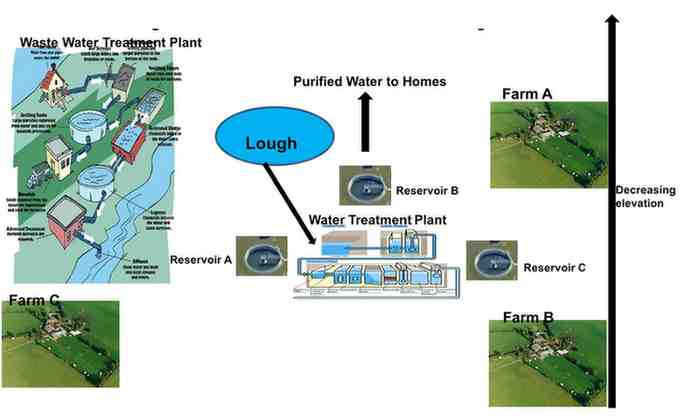
Figure 1.1. Map showing geographical locations of wastewater treatment plant, water treatment plant, service reservoirs and surrounding farmland in relation to Newtown, where the gastroenteritis outbreak occurred.
➢ MTU Environmental Science Assignment Support
Many mtu students find the envi7001 environmental science case study challenging because it requires linking chemical, physical, and biological water test results to identify the most likely contamination source. There is no need to feel overwhelmed, as case study writing help by Ireland Assignments provides structured, lab-aligned analytical support. For quality assurance, students can explore our case study samples, prepared by subject specialists. Choose our assignment writing service for a custom, human-written environmental science solution tailored to your case study.